Introduction: The New Era of “Asset-Light” Trade
Gone are the days when starting an export business required a massive warehouse, a fleet of trucks, and millions in capital locked up in stock. In 2026, the global trade landscape has shifted dramatically toward “Asset-Light” business models. With the rise of AI-driven logistics, blockchain-secured contracts, and hyper-connected B2B platforms, the barrier to entry has never been lower.
Today, the most successful new entrants aren’t the ones with the most inventory; they are the ones with the best information and connections. Starting an export-import business with zero inventory—often referred to as being a Merchant Exporter or utilizing Cross-Border Dropshipping—is not just possible; it is one of the smartest ways to mitigate risk in a volatile global economy.
What Does “Zero Inventory” Mean?
In a traditional model, you buy goods, store them, and then try to sell them. In a zero-inventory model, you sell first and buy later. You act as a vital bridge between a domestic manufacturer (who makes the product) and an international buyer (who needs it). You never physically hold the stock; you simply manage the flow of goods and documentation, earning a profit on the margin.
Business Models for Zero Inventory in 2026
To operate without a warehouse, you must choose the right structure. Here are the three most effective models for 2026:
1. The Merchant Exporter Model (Sourcing on Demand)
This is the gold standard for B2B trade. You secure an order from an international buyer first. Once the purchase order (PO) and payment guarantee (like a Letter of Credit) are in hand, you pay the domestic manufacturer to produce or release the goods.
- Advantage: You use the buyer’s commitment to fund the production/procurement.
- 2026 Twist: Use AI tools to match global demand spikes with local idle manufacturing capacity instantly.
2. Cross-Border Dropshipping
Ideal for B2C e-commerce. You list products on an international storefront (like Shopify or Amazon Global Selling). When a customer in the US or UK buys a product, your supplier in India (or elsewhere) ships it directly to the customer’s doorstep.
- Advantage: You only pay for the product after the customer has paid you.
- Challenge: Quality control is harder since you never see the product.
3. Service & Digital Product Exports
Often overlooked, this sector is booming. Exporting consultancy, software, architectural designs, or educational content requires absolutely no physical inventory.
- Advantage: 100% profit margin on the product itself (minus time/marketing costs).
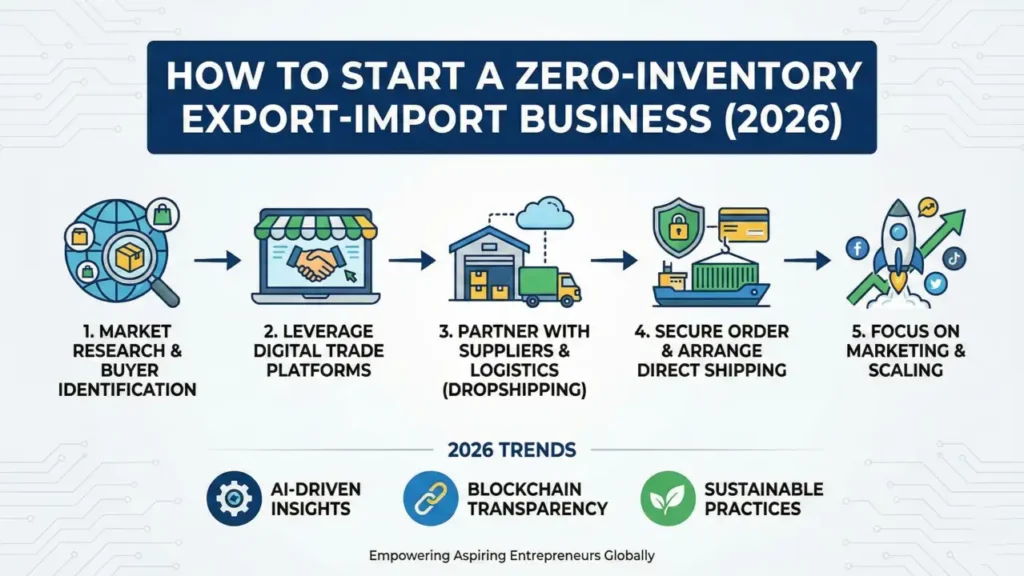
Key Steps to Start (The “Zero Risk” Framework)
- Niche Selection: Do not try to export “everything.” In 2026, specificity wins. Instead of “Leather Goods,” choose “Vegan Mushroom Leather Wallets.”
- Compliance First: You cannot trade without a passport. Get your Import Export Code (IEC), register for GST, and obtain an AD Code (Authorized Dealer Code) from your bank. These are mandatory digital footprints.
- Find “Export-Ready” Suppliers: You need manufacturers who are willing to white-label products for you and understand quality standards. Your supplier is your inventory.
- Secure the Buyer: Use platforms like LinkedIn, trade fairs, or B2B marketplaces to find buyers. Negotiate terms where the buyer pays an advance (e.g., 30-50%), which you use to pay the supplier.
How Sandlya Exim Academy Can Help
The zero-inventory model sounds simple, but the devil is in the details—specifically in documentation and risk management. A slight error in a Letter of Credit can leave you liable for goods you haven’t paid for yet.
Sandlya Exim Academy specializes in bridging the gap between “theory” and “transaction.” Here is how they assist aspiring zero-inventory entrepreneurs:
- Practical Documentation Training: Trading without stock means you live and die by your paperwork. Sandlya Exim Academy offers deep-dive courses on Incoterms 2020/2030 and Export Documentation. They teach you how to structure contracts so that ownership of goods transfers directly from supplier to buyer, minimizing your liability.
- Supplier & Buyer Connection Strategies: One of the hardest parts of zero-inventory trading is finding a manufacturer who trusts you. The Academy’s Export Entrepreneurship Course provides templates for supplier agreements and negotiation scripts that help you look professional even if you are a one-person army.
- Risk Management Mentorship: What happens if the buyer cancels after you’ve ordered from the factory? Sandlya Exim Academy places a huge emphasis on Credit Risk Insurance (ECGC). They guide you on how to insure your payments so that even if a buyer defaults, your capital is safe.
- Current Market Trends (2026 Focus): The faculty at Sandlya consists of active traders who understand the 2026 regulatory environment, including the latest export incentives (like RoDTEP) that you can claim even as a merchant exporter.
Conclusion
Starting an export-import business in 2026 does not require deep pockets; it requires deep insight. By adopting a zero-inventory model, you free yourself from the shackles of warehousing and unsold stock, allowing you to focus on what matters most: finding markets and building relationships.
With the right guidance from institutions like Sandlya Exim Academy, you can navigate the complexities of global trade with confidence, turning your laptop into a gateway for international business.
Please contact our support team for a free consultation. 👇
📧 Email: sandlyaeximacademy@gmail.com 🌐 Web: www.sandlyaacademy.com