Introduction
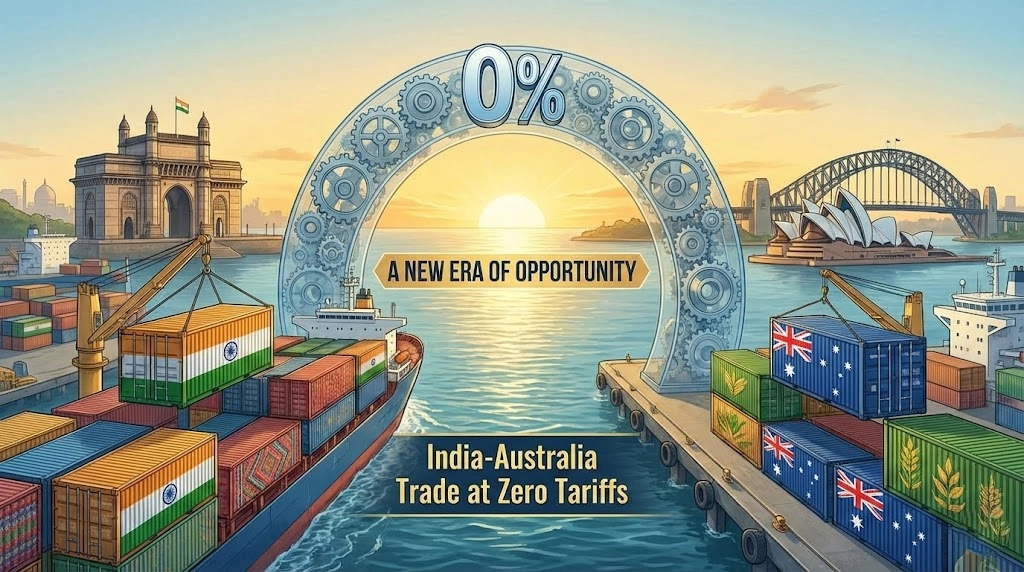
The global trade map is being redrawn, and at the center of this shift is the burgeoning partnership India-Australia Trade at Zero Tariffs. As of January 1, 2026, a historic milestone has been reached under the India-Australia Economic Cooperation and Trade Agreement (ECTA): Australia has eliminated tariffs on 100% of Indian goods exports.
This “Zero Tariff” regime is not just a policy update; it is a transformative opportunity for businesses in both nations. For Indian exporters, the doors to a $2 trillion economy are now wide open. For Australian businesses, access to the world’s fastest-growing major economy has never been easier. However, capitalizing on this opportunity requires deep knowledge, strategic planning, and expert guidance.
Overview of India-Australia Trade at Zero Tariffs
The relationship between New Delhi and Canberra has evolved from cricket and commonwealth ties to a robust strategic economic partnership. Since the ECTA came into force in late 2022, bilateral trade has surged, crossing A$50 billion (approx. ₹3 lakh crore) for the first time.
While India’s global exports have grown steadily, exports to Australia have skyrocketed, growing significantly faster than India’s average export rate. This underscores a critical fact: the two economies are naturally complementary. Australia possesses the resources (critical minerals, energy) that India’s manufacturing engine needs, while India produces the finished goods (textiles, pharmaceuticals, tech) that Australian consumers demand.
Benefits of Zero Tariffs: Who Wins?
The elimination of duties is a game-changer for cost competitiveness. Here are the key sectors reaping the rewards:
1. Labor-Intensive Indian Sectors
Historically, Indian goods faced a 4-5% duty disadvantage compared to competitors like China or Vietnam. With 100% tariff lines now at zero, the following sectors are witnessing a boom:
- Textiles and Apparel: Readymade garments and home textiles are now cheaper for Australian buyers, driving volume.
- Gems and Jewellery: A major export winner, now entering Australia duty-free.
- Leather and Footwear: High-quality Indian leather goods are now more competitive against global rivals.
2. Australian Resource & Agri-Exports
India has reciprocated by reducing or eliminating duties on key Australian exports:
- Wines: Tariffs on premium Australian wines have been slashed, making them more accessible to Indian consumers.
- Agriculture: Critical commodities like almonds, lentils, oranges, and pears have seen duty reductions, benefiting Indian food processors and consumers.
- Minerals: Coal and critical minerals (essential for India’s EV and renewable energy push) now flow more smoothly, powering India’s industrial growth.
Challenges for Businesses
Despite the “Zero Tariff” headline, the path to profit is not without obstacles. Businesses must navigate several complexities:
- Rules of Origin (ROO): To claim zero duty, exporters must prove that their goods truly “originate” in India or Australia. Simple trans-shipment of third-party goods is strictly prohibited. Understanding the “value addition” criteria is complex but essential.
- Non-Tariff Barriers: Even with zero tariffs, goods must meet strict Sanitary and Phytosanitary (SPS) measures. Australian standards for food safety and biosecurity are among the toughest in the world.
- Documentation Rigor: A single error in the Certificate of Origin can lead to shipment rejection or full duty leviability at the port of destination.
The Role of Sandlya Exim Academy
Navigating these waters requires more than just enthusiasm; it requires expertise. This is where Sandlya Exim Academy steps in as a vital partner for aspiring and established traders.
- Specialized Training on Free Trade Agreements (FTAs) We don’t just teach generic export theories. Our curriculum is updated to include deep dives into specific agreements like the India-Australia ECTA. We train you on how to calculate “Value Added” content to satisfy Rules of Origin requirements.
- Documentation & Compliance Workshops Sandlya Exim Academy offers practical workshops on filing the correct documentation. We ensure our students and clients understand exactly how to apply for a Certificate of Origin (CoO) through the proper government portals to claim duty benefits.
- Market Intelligence & Consultancy For businesses unsure of where to start, our consultancy wing provides tailored advice. We help you identify which of your specific products benefit most from the zero-tariff regime and connect you with the right entry strategies for the Australian market.
- Bridging the Quality Gap Since Australian standards are high, we educate exporters on Quality Control (QC) and international standards compliance, ensuring your goods don’t just reach the Australian border but cross it successfully.
Conclusion
The era of zero tariffs between India and Australia is here, offering a competitive edge that businesses cannot afford to ignore. The “duty-free” tag is a ticket to higher margins and new market share, but it is valid only for those who understand the rules of the game.
With the right guidance from Sandlya Exim Academy, you can turn these trade policy shifts into tangible business growth. Whether you are a student aspiring to be a trade analyst or a business owner eyeing global expansion, now is the time to skill up and ship out.